Which hours are cheapest? How to save with timers, Nord Pool data, and Smart Kilowatts
As electricity costs keep rising, cheapest-hour scheduling can reduce the bill without a large upfront investment. This guide shows how to use historical Nord Pool data, simple timers, and when dynamic Smart Kilowatts control adds value.

Electricity costs increasingly feel as if they only move one way: up. There are several ways to reduce the bill: consume less, replace inefficient appliances, install solar panels, or add a home battery. Those can be good decisions, but they usually require a larger upfront investment, even when support programs such as APVA solar support or guidance in the APVIS/APVA FAQ are available.
This article focuses on a simpler approach that is easy to miss: not only how much electricity you use, but when you use it.
Many devices do not need to run all the time
Some home loads do not need to be on 24 hours a day. If pool water needs 12 hours of filtering per day, why should the pump run continuously? If a plug-in hybrid is connected for 12 hours but needs only 9 hours of charging, why charge during the most expensive hours?
The same idea can apply to a water heater, recuperator, ventilation, dehumidifier, air conditioner, or water cleaning/aeration equipment. The important condition is safety: switching must not break hygiene, comfort, manufacturer limits, wiring limits, or appliance requirements.
How to find the hours
Historical Nord Pool data helps here. It does not predict the future perfectly, but it shows recurring patterns: which hours were cheap most often, whether seasons behave differently, and whether it is worth changing a timer two or four times per year.
Smart Kilowatts Best Time Search makes this practical for a normal user: choose a country, choose how many hours per day the device must run, decide whether hours may be split, and get a timer-friendly schedule.
Example devices and schedules
The experiments below use Lithuania historical Nord Pool data from 2025-05-01 to 2026-04-30. The numbers are not a promise, but they show the size of the opportunity.
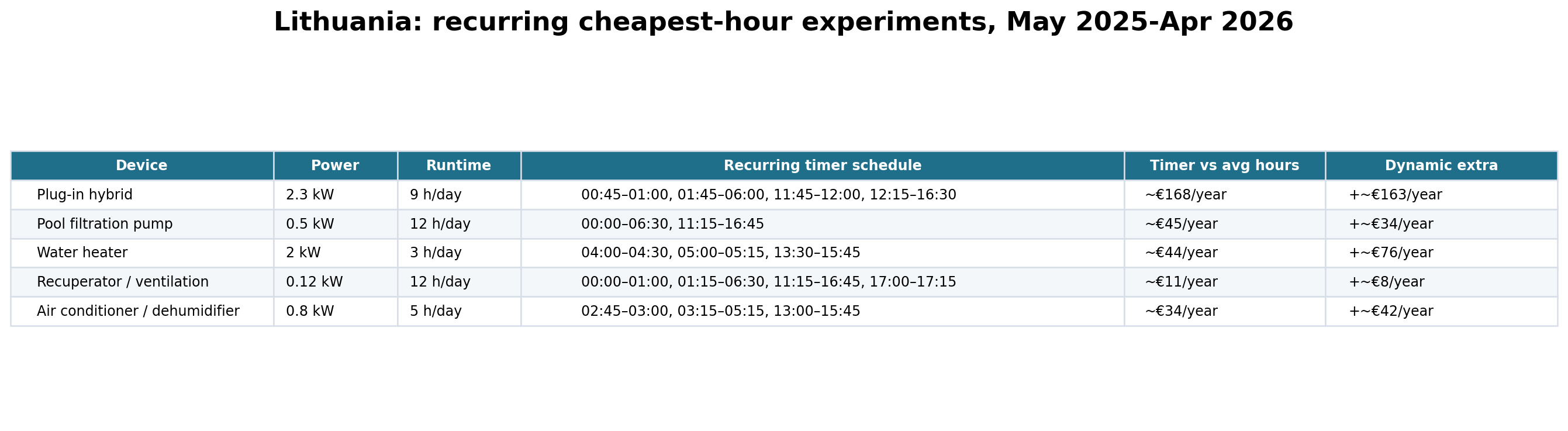
For example, in the plug-in hybrid scenario, a recurring historical timer saved about EUR 168 per year compared with running the same 9 hours at average daily prices. Dynamic day-ahead control, where the schedule is recalculated from tomorrow's prices, added about EUR 163 per year in the same model. You can open this setup in the emulator.
Open examples: plug-in hybrid, pool pump, water heater, recuperator, air conditioner or dehumidifier.
Should you change the timer by season?
One timer schedule is the easiest start. But price patterns move across the year: summer daytime hours may become cheaper because of solar generation, while winter cheap hours often move back toward night. That is why it is useful to compare the overall result with two-season and four-season views.
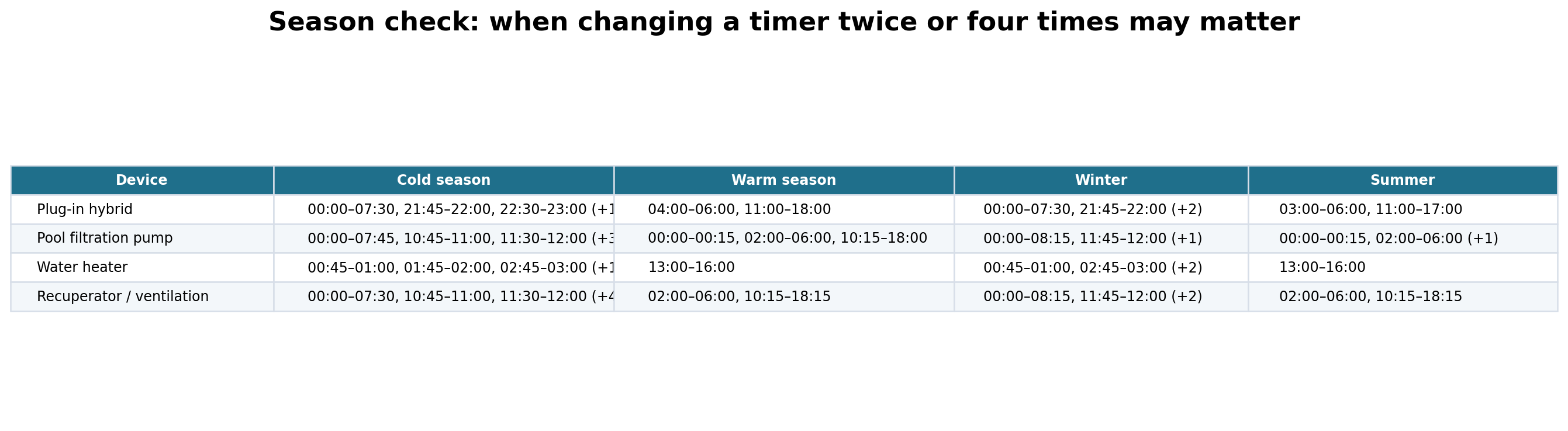
If the seasonal rows look similar, one timer can be enough. If they differ clearly, changing a mechanical timer twice per year may be worthwhile. Four seasons give more precision, but also require more manual discipline.
What automatic control can add
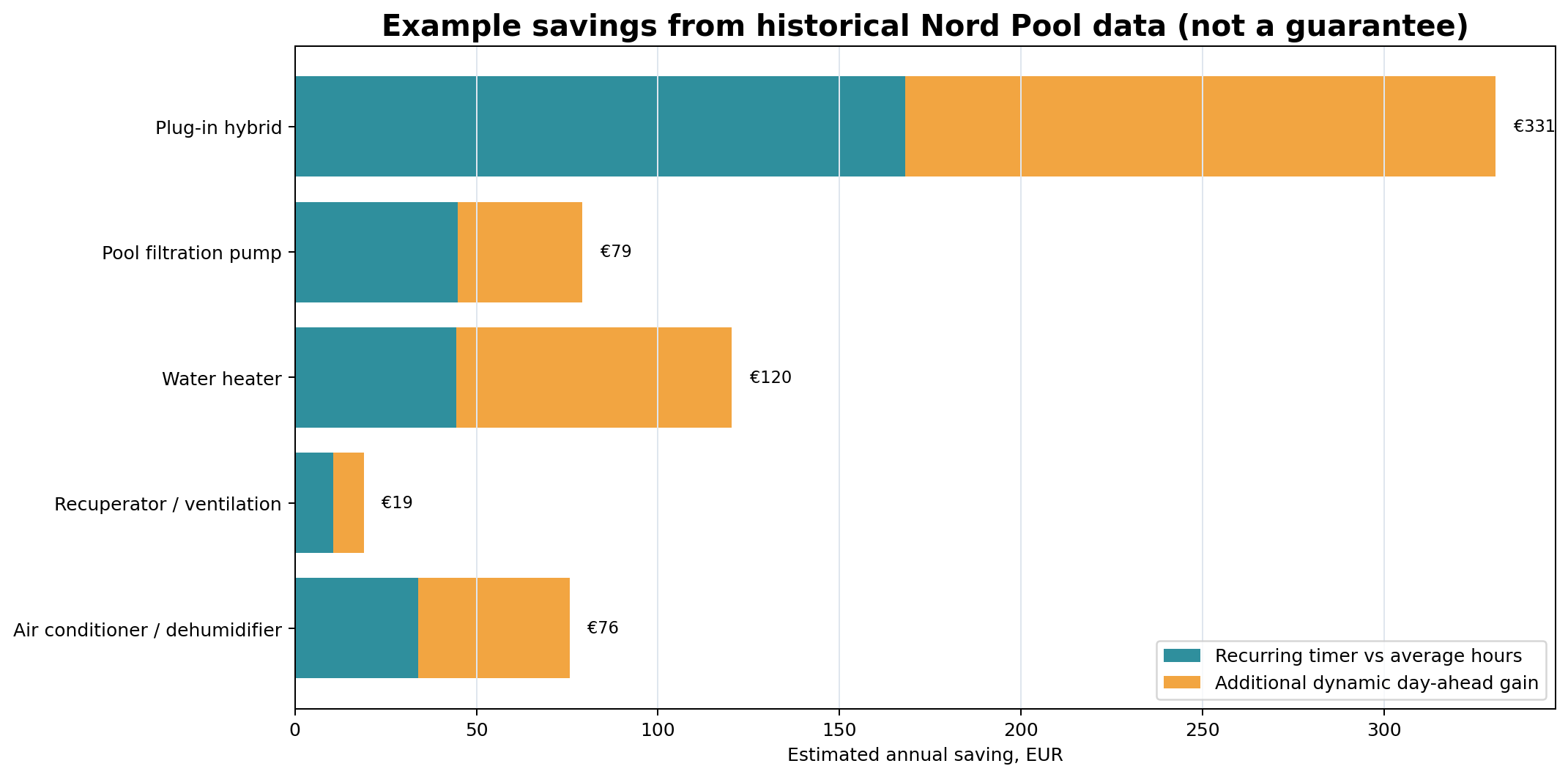
A cheap mechanical timer follows one recurring historical schedule. That is a good first step because the investment is small and savings can start almost immediately. But it does not know tomorrow's prices, weekends, unusual price spikes, or the real device state.
Smart Kilowatts uses day-ahead prices and can choose the cheapest hours every day according to your rule. That matters most for higher-power devices, longer runtimes, and clear availability windows such as car charging. Hardware is available on the Products page, and subscriptions are on the Plans page.
Limitations
These calculations use historical prices. Future Nord Pool prices may behave differently, so a historical cheapest-hour schedule is an estimate, not a guarantee. You must also check appliance instructions, safety, hygiene, comfort, wiring, relay, and plug ratings.
If you want the smallest first step, choose one safe device, calculate cheap hours, and try a mechanical timer. If you want more accurate control without manual seasonal changes, move to automatic day-ahead scheduling.
Related setups
-
Open Best Time Search
Try the historical cheapest-hours tool.
-
Open emulator setup
Compare a timer and dynamic scheduling.
-
Products
Smart Kilowatts hardware.
-
Plans
Subscription options.